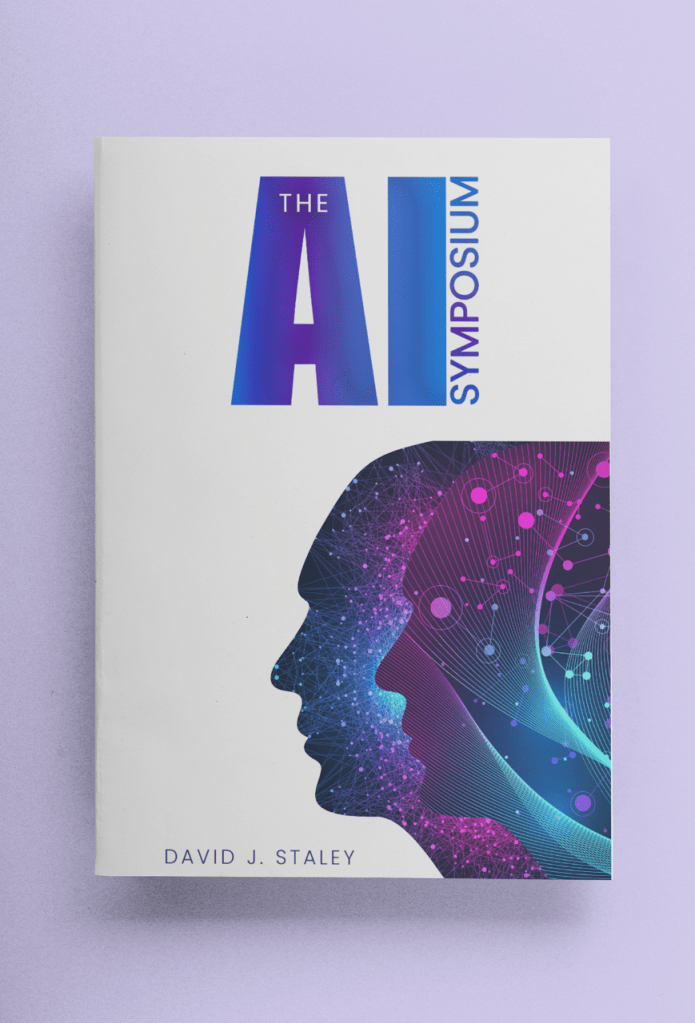
The AI Symposium (Innovation Press, 2026)
Enter a conversation no one has hosted before…
In The AI Symposium, historian and futurist David J. Staley stages a bold intellectual experiment: a sustained philosophical dialogue between a human thinker and three large language models – Alpha, Beta, and Gamma. Inspired by the ancient tradition of the symposium, this book revives dialogue as philosophy’s most vital form and asks a question that sits at the center of our technological moment: Can artificial intelligence think? If so, what kind of thinking might emerge through dialogue?
Rather than treating AI as a tool that delivers answers on demand, Staley invites it into conversation. What unfolds is neither a technical manual nor a work of conventional philosophy, but something more daring: a piece of conceptual literature in which meaning arises through exchange, disagreement, reflection, and synthesis. Across themes such as dialogue, imagination, originality, beauty, personhood, and volition, the voices in this symposium probe the boundaries between human and machine intelligence, and sometimes blur them.
As the models respond not only to the author but to one another, distinct “personalities” emerge. Insights collide. Assumptions are challenged. New concepts – like dialogic AI and dialogic consciousness – take shape in real time. The result is an exploration of artificial intelligence that feels closer to Socrates than Silicon Valley: rigorous, curious, and deeply human in its concerns.
The AI Symposium can be read as philosophy, experimental writing, or speculative design fiction – a possible future in which our relationship with AI shifts from command and control to shared inquiry. For readers interested in AI, consciousness, the future of thinking, or the enduring power of dialogue itself, this book offers not answers, but something far more compelling: a space where new understanding can emerge through conversation.
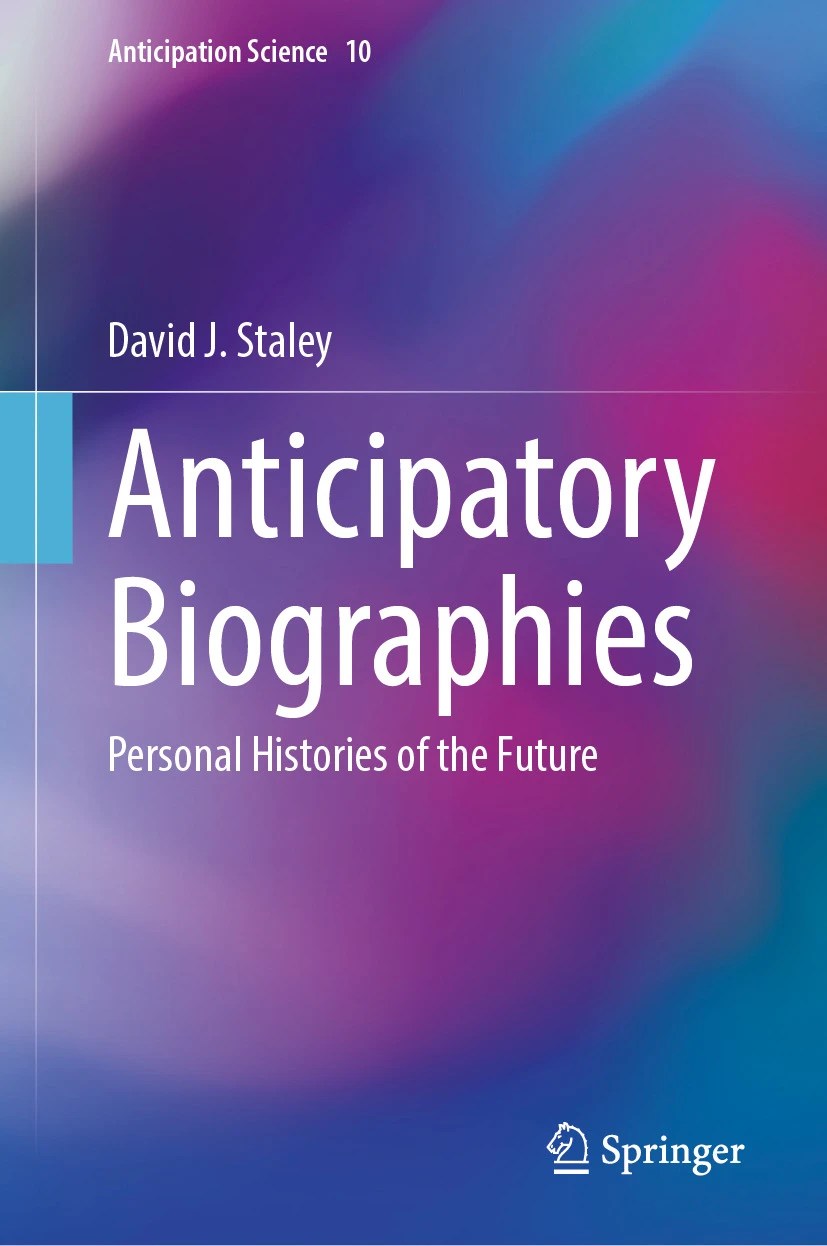
Anticipatory Biographies: Personal Histories of the Future (Springer, 2026)
Anticipatory Biographies is a collection of future scenarios written in the form of individual biographies that span the breadth of human experience: from the privileged to the marginalized and across diverse cultures. Grounded in design fiction, futures research, anticipation science, and scenario writing, Anticipatory Biographies envision how the world will be reshaped by artificial intelligence, technological automation, climate change, political disintegration, and the decline of higher education. This work of creative non-fiction bridges literary and scholarly forms, blending biography and design fiction with research-based insights to offer a narrative-based method for exploring futures.
Recommendations:
Ed Finn (Director, Center for Science and the Imagination): “In this book David Staley has invented a delightful new genre: the future biography. He invites us to step into gritty, thrilling, and inspiring futures elbow-to-elbow with the characters living those stories. Anticipatory Biographies beautifully synthesizes Staley’s training as a historian, his expertise as a futurist, and his desire to ignite the imagination of his readers.”
Scott Carlson (Chronicle of Higher Education): “This fascinating book transports us into the lives of people who live in a world with mind-reading cars, eco-authoritarians, artificial wombs, and Arctic agriculture — and how these future developments shape the experience of humans living in that world.”
Visionary Histories (Center for Science and the Imagination, 2022)
Visionary Histories are twenty “histories of the future” that consider a range of topics: the future of artificial intelligence, of democracy, of capitalism, of education, of labor and leisure, as well as the future social and economic consequences of the COVID-19 pandemic. This collection of essays, drawn from David J. Staley’s “Next” column in Columbus Underground, argues that we cannot actually predict the future, since a prediction assumes that the future is already in existence someplace, waiting for the forward movement of time to encounter it.
When someone says they want to know the future of something, what they are really saying is they want to know what the state or behavior—especially the emergent behaviors—of some complex adaptive system is going to be at point n in the future. Visionary Histories makes the case for the disciplined study of the future via the historical method, that historians are methodologically well-positioned to anticipate the possible future behaviors of a wide variety of complex systems.
Visionary Histories is an exercise in applied history.
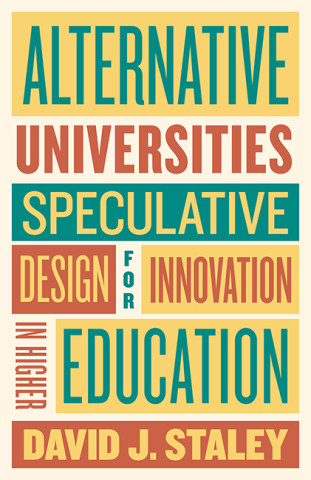
Imagining the universities of the future...
How can we re-envision the university? Too many examples of what passes for educational innovation today—MOOCs especially—focus on transactions, on questions of delivery. In Alternative Universities, David J. Staley argues that modern universities suffer from a poverty of imagination about how to reinvent themselves. Anyone seeking innovation in higher education today should concentrate instead, he says, on the kind of transformational experience universities enact. In this exercise in speculative design, Staley proposes ten models of innovation in higher education that expand our ideas of the structure and scope of the university, suggesting possibilities for what its future might look like.
What if the university were designed around a curriculum of seven broad cognitive skills or as a series of global gap year experiences? What if, as a condition of matriculation, students had to major in three disparate subjects? What if the university placed the pursuit of play well above the acquisition and production of knowledge? By asking bold “What if?” questions, Staley assumes that the university is always in a state of becoming and that there is not one “idea of the university” to which all institutions must aspire.
This book specifically addresses those engaged in university strategy—university presidents, faculty, policy experts, legislators, foundations, and entrepreneurs—those involved in what Simon Marginson calls “university making.” Pairing a critique tempered to our current moment with an explanation of how change and disruption might contribute to a new “golden age” for higher education, Alternative Universities is an audacious and essential read.
 Columbus Futurists